By the Vertexweb team. Last reviewed .
Most small business SEO mistakes are not complicated. They are small oversights that add up: a missing page title, a slow mobile site, a half-finished Google profile. The good news is that most are quick to fix once you know where to look.
This guide lists ten common mistakes, explains why each one hurts and shows how to put it right. It is written for owners who want practical steps, not jargon.
Key takeaways
- Most SEO problems come from basics being missed, not from advanced tricks.
- Fix speed, mobile layout and page titles before anything fancy.
- Local businesses should start with a complete Google Business Profile.
- Avoid shortcuts such as bought links and keyword stuffing.
- Track enquiries, not just rankings.
Strategy mistakes
1. Having no clear goal
SEO without a goal wanders. Decide what you want, such as calls, bookings or form enquiries, and measure that.
2. Chasing only big, broad keywords
Competitive terms are hard for a small site. Target specific searches that match what customers really want, such as a service plus a place.
3. Ignoring local search
If you serve a local area, your Google Business Profile matters as much as your website. See our Google Business Profile guide and local SEO services.
Technical mistakes
4. A slow or awkward mobile site
Most local searches happen on phones. Compress images, keep pages light and design for small screens first. Read why you need a mobile-first website and how to speed up your site.
5. Missing or duplicate page titles and descriptions
Every page needs a unique title and a clear description of what it offers.
6. Broken links and messy redirects
Check for pages that return errors and make sure old addresses redirect to the right new page, not the home page.
7. Accidentally blocking search engines
Many sites are hidden from search while being built and then launched with the setting still on. Check your site visibility settings and robots file after launch.
Content and link mistakes
8. Thin or copied content
Pages that repeat each other, or copy other websites, offer little value. Write original, helpful pages for each service. Our guide to writing blog posts that rank shows how.
9. Buying links or using shortcuts
Paid link bundles and keyword stuffing can do more harm than good. Earn mentions from relevant local sites instead.
10. Not tracking results
Without tracking, you cannot tell what works. Set up analytics and Search Console, and watch calls, forms and bookings.
A ten-minute SEO check you can do today
- Search your business name and check what appears.
- Open your site on a phone and time how long it takes to load.
- Check that every page has a unique title.
- Confirm your Google Business Profile is complete and accurate.
- Click your main links and forms.
- Ask whether each page has one clear next step.
Use our small business website checklist for a fuller review.
Which mistakes to fix first
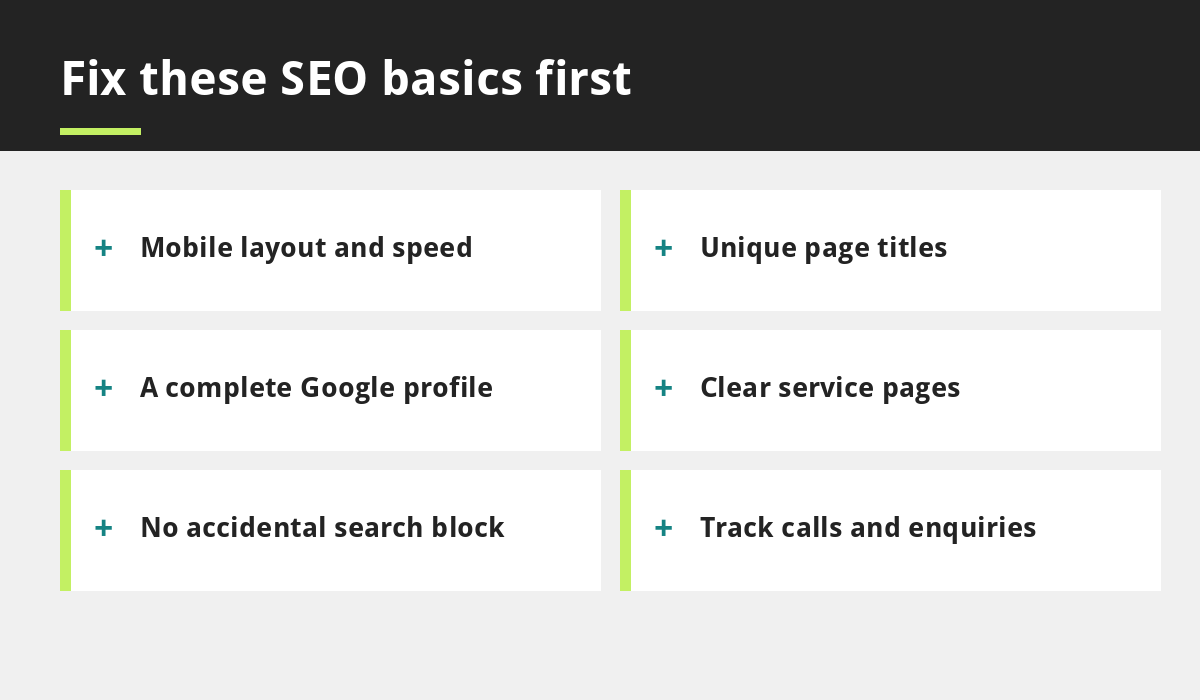
Fix in order of impact: mobile layout and speed, page titles, your Google Business Profile, then content depth and links. Make one change at a time and note the date, so you can see what helped. If you would like a professional review, see our SEO service.
A local SEO starter checklist
- Claim and complete your Google Business Profile.
- Keep your name, address and phone number the same everywhere.
- Add your town or area to your home and contact pages in natural wording.
- Create a page for each main service.
- Ask happy customers for honest reviews, and reply to all of them.
- Add a map and directions to your contact page.
- Check your site on a real phone.
Working through even half of this list puts many small businesses ahead of competitors who have not done the basics.
Examples of small fixes that make a difference
These are illustrations to show the idea, not real results. A cafe discovered that its opening hours differed between its website and its Google profile, so it matched them and stopped losing customers who arrived at a closed door. A tradesperson added one page for each service instead of listing everything on the home page, which made each service easier to find and to understand. A salon compressed its gallery images so pages loaded in a few seconds instead of many, and visitors stayed longer. None of these needed advanced tools, only attention to detail.
Free tools that help you check
- Google Search Console shows how your site appears in search and highlights errors.
- Google Analytics shows visits and what people do on your site.
- PageSpeed Insights tests loading speed and mobile experience.
- Your Google Business Profile dashboard shows calls, directions and website clicks.
Set these up early so you have a record of how things change after each fix.
When to ask for professional help
Do it yourself while the tasks are simple. Consider help when you are stuck on technical problems, when several competitors are well established, when you have multiple locations or when you simply do not have the time. A good adviser will explain what they will do, why and how they will measure it, and will never guarantee a ranking. Explore our SEO service and local SEO services.
Common questions
How long does SEO take?
Some fixes help within weeks, but meaningful results usually build over several months.
Can I do SEO myself?
Yes, many basics are manageable. A professional can help with technical issues, content and local strategy.
Final thoughts
Avoiding these ten small business SEO mistakes puts you ahead of many competitors. Keep it simple: serve mobile users, write clear pages, complete your Google profile and measure what matters.
Want a hand? Get in touch or explore our local SEO services.
Related reading
- Location Pages for SEO Without Duplicate Content
- How Local SEO Helps UK Businesses Win Customers Nearby
- Why Your Business Needs a Mobile-First Website
- How to Speed Up Your Small Business Website
- Our SEO service
Launch offer for UK small businesses. Get a professional website for just £299 a year, with free domain, hosting and SSL for the first year. Only the first 20 customers.