
By the Vertexweb team. Last reviewed November 2026.
Most small business websites need between 5 and 15 pages, but the right number depends on how many services you offer and how many areas you serve. Too few pages and Google cannot tell what you do. Too many thin pages and your site feels empty and is harder to keep up to date. This guide explains the essential small business website pages, the pages worth adding as you grow and the ones you can skip.
Key takeaways
- Start with five core pages: Home, About, Services, Contact and a privacy policy.
- Give each main service its own page so it can rank.
- Add location pages only for areas you genuinely serve.
- A blog helps answer customer questions and build trust.
- Quality matters more than page count.
The essential small business website pages
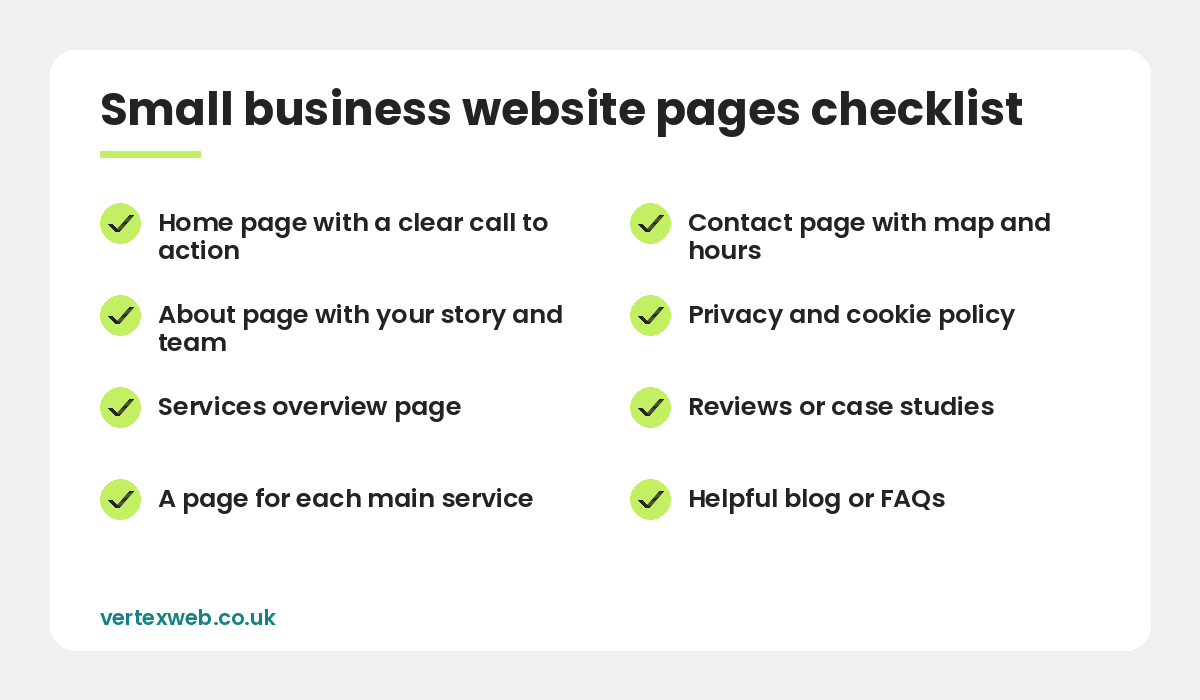
- Home. Explains what you do, who for and where, with a clear call to action.
- About. Your story, team, experience and why customers should trust you. See our About Us page guide.
- Services. An overview of everything you offer.
- Contact. Phone, email, form, map, opening hours and areas served.
- Privacy policy. Required if you collect any personal data, including contact form enquiries.
That gives you a solid five-page website. Many new businesses start here.
Give each main service its own page
If you offer several different services, one page listing them all will struggle to rank for any of them. A plumber who offers boiler repairs, bathroom fitting and emergency callouts should have a page for each. Each page can explain the service, prices or price guides, process, FAQs and reviews related to that work.
As a rule of thumb, if customers search for it separately, it deserves its own page.
Pages worth adding as you grow
- Location pages for the main towns you serve, each with unique, useful content.
- Portfolio or case studies showing real work and results.
- Reviews or testimonials gathered in one place.
- FAQ page answering common questions about price, timing and process.
- Blog with helpful guides that answer what customers ask.
- Pricing page if you can share prices or packages.
Examples by business type
Local cafe: Home, Menu, About, Events, Contact. Around 5 to 7 pages.
Tradesperson: Home, About, 3 to 6 service pages, 2 to 4 area pages, Reviews, Contact. Around 10 to 15 pages.
Clinic: Home, About, Team, treatment pages, Prices, FAQs, Book, Contact. Often 12 to 25 pages.
Online shop: Core pages plus category and product pages, delivery and returns policy.
Does page count affect SEO?
More pages do not automatically mean better rankings. What matters is having a strong, helpful page for each thing people search for. Ten thin pages with copied text can hurt you, while one excellent page can rank well. Focus on covering your services and locations properly and keep every page up to date.
Common questions
Is a one-page website enough for a small business?
It can work for a very simple business, but it is hard to rank for several services or areas with one page. Most businesses benefit from at least five pages.
How many service pages should I have?
One for each main service customers search for separately. For many small businesses that is three to eight.
Do more pages cost more?
Usually yes, because each page needs design and content. Start with the essentials and add pages over time.
Do I need a blog?
Not on day one, but a blog with helpful answers to customer questions is one of the best ways to grow traffic over time.
Final thoughts
When planning your small business website pages, start with the essentials, give each important service its own page and add location pages, reviews and guides as you grow. Use our website content checklist to plan what to write on each page, or see our small business website design service.
Want help with this?
We can plan your page structure and build a website that covers every service and area properly. Request a free quote or call +44 7446 776057.