
By the Vertexweb team. Last reviewed November 2026.
Google Maps ranking factors come down to three things: how relevant you are, how close you are and how well known you are. When someone searches for ‘electrician near me’ or ‘Indian restaurant’, the map results often get more clicks than anything else on the page. This guide explains the main Google Maps ranking factors in plain English and the steps that make the biggest difference for UK small businesses.
Key takeaways
- Google says local rankings depend on relevance, distance and prominence.
- Your primary category is one of the strongest relevance signals.
- You cannot change distance, but you can make your location and service area clear.
- Reviews, links and consistent listings build prominence.
- Keyword stuffing your business name can get your profile suspended.
The three main Google Maps ranking factors
Google’s own help pages explain that local results are based mainly on relevance, distance and prominence.
- Relevance is how well your profile matches what someone searched for.
- Distance is how far your business is from the searcher or the location in the search.
- Prominence is how well known your business is, online and offline. Reviews, links, mentions and your website’s overall strength all play a part.
How to improve relevance
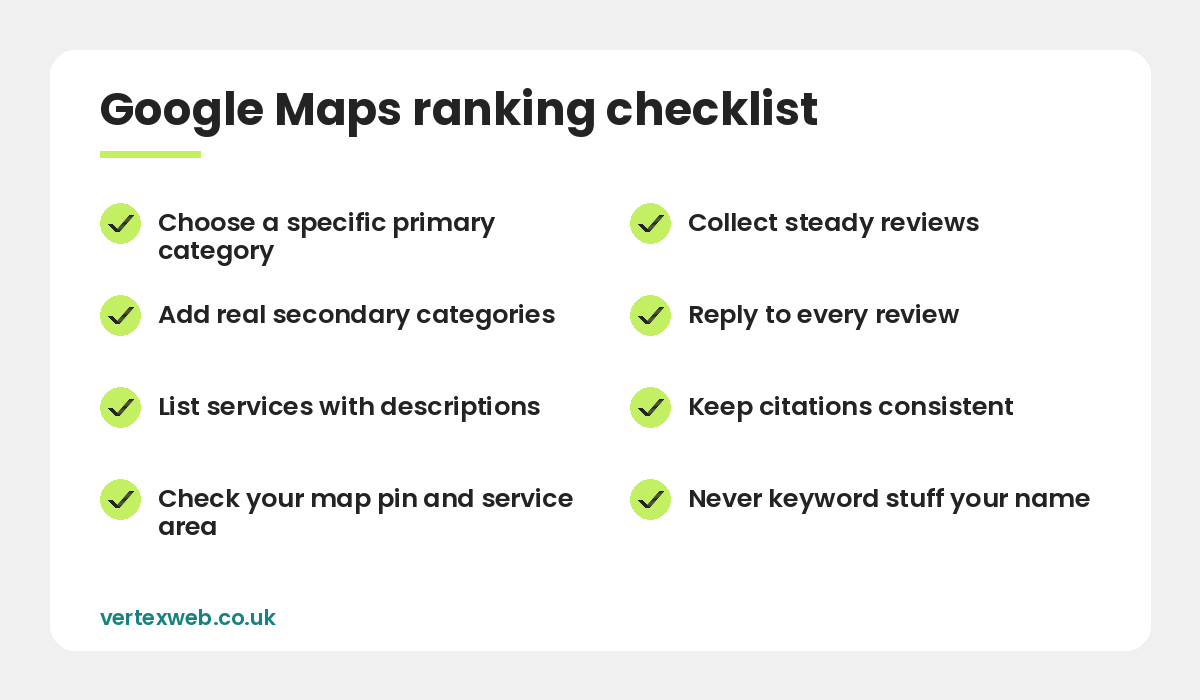
- Choose the right primary category. Be specific. ‘Emergency locksmith service’ is better than ‘Locksmith’ if that is your main work, and ‘Dentist’ or ‘Cosmetic dentist’ depending on your focus.
- Add secondary categories for other real services.
- List your services and products with short descriptions.
- Write a clear description that explains what you do and where.
- Link to a strong website page that matches your main service and location.
What you can do about distance
You cannot move closer to every customer, but you can help Google understand where you are. Use your real address, place the map pin accurately and, if you travel to customers, set a service area. Mention the towns and areas you serve on your website, and create useful pages for your main areas.
How to build prominence
- Reviews. Steady, genuine reviews with detailed text. Reply to all of them.
- Citations. Consistent name, address and phone number on trusted directories.
- Links. Links from local organisations, suppliers, sponsors and press.
- Activity. Regular photos, posts and updated hours show the business is active.
- Website quality. A fast, helpful website supports your profile.
What to avoid
- Adding keywords or locations to your business name.
- Creating fake locations or virtual office listings.
- Buying or swapping reviews.
- Changing your category or name repeatedly.
These can lead to a suspension, which removes you from Maps completely.
Common questions
What is the most important Google Maps ranking factor?
There is no single factor, but your primary category, distance from the searcher and your reviews are among the strongest signals.
Do reviews help Google Maps rankings?
Yes. The number, quality and recency of reviews help prominence, and good reviews make people more likely to click.
Can I rank in Maps for a town where I have no address?
It is hard to appear in the map pack far from your address. A service area and strong location pages can help, but do not create fake addresses.
How long does it take to rank higher in Google Maps?
Small fixes like categories can show results within weeks. Building reviews and links usually takes a few months.
Final thoughts
The Google Maps ranking factors are not secret. Be as relevant as possible with categories and services, make your location clear, and keep building reviews and local links. Read our Google Business Profile guide or see our Google Business Profile optimisation service.
Want help with this?
We can audit your profile against the main ranking factors and fix the issues holding you back. Request a free quote or call +44 7446 776057.