
By the Vertexweb team. Last reviewed November 2026.
Keyword research for small businesses is simply finding the words your customers type into Google, then building pages that answer them. You do not need expensive software to get started. Free tools and a bit of common sense will show you what people search for, how they phrase it and which questions they ask. This guide walks through a simple process you can finish in an afternoon.
Key takeaways
- Start with your services and the areas you serve.
- Use Google autocomplete and People Also Ask for real phrases.
- Google Keyword Planner gives rough search volumes for free.
- Search Console shows the words already bringing you visitors.
- Match each keyword group to one page.
Step 1: List your seed keywords
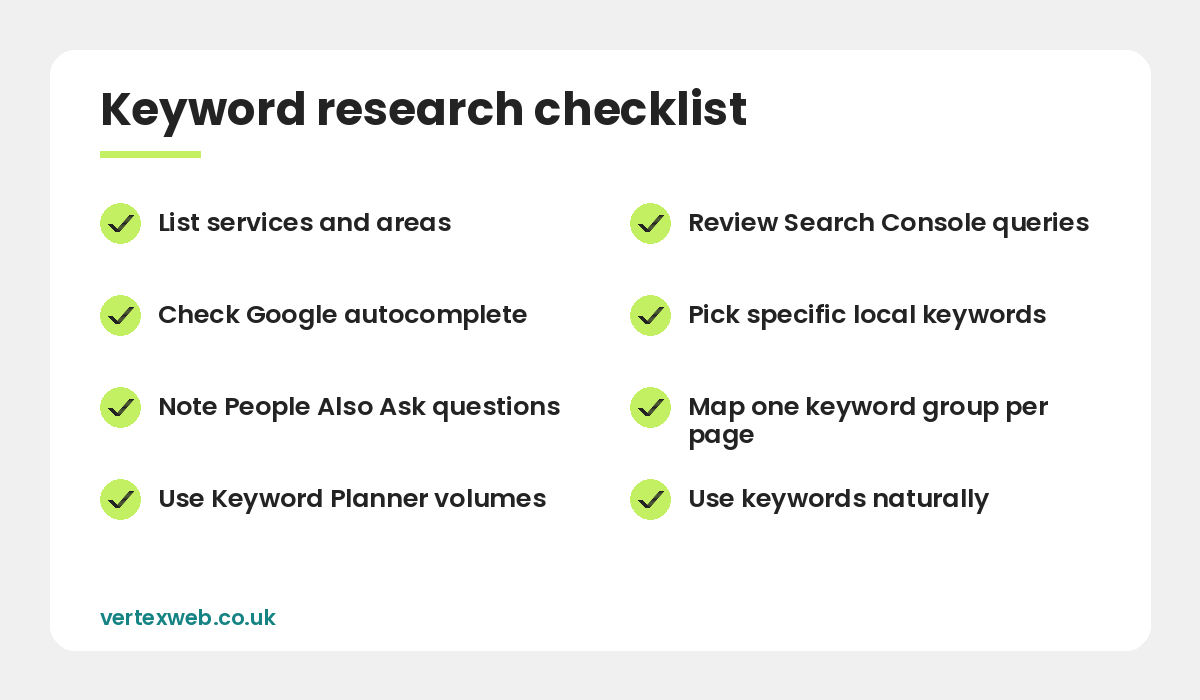
Write down every service you offer, the problems you solve and the places you serve. A dog groomer in Leeds might list ‘dog grooming’, ‘puppy groom’, ‘mobile dog groomer’, ‘dog grooming Leeds’ and ‘dog grooming Headingley’. Think about how a customer would describe the problem, not how the industry would.
Step 2: Expand with free tools
- Google autocomplete: type your seed keyword and note the suggestions.
- People Also Ask: the question boxes in Google results show real customer questions.
- Related searches: at the bottom of the results page.
- Google Keyword Planner: free inside Google Ads. Shows rough monthly searches and suggestions.
- Google Search Console: the queries already showing your site.
- Google Trends: seasonal patterns, such as when ‘boiler service’ peaks.
- AnswerThePublic: limited free searches for question ideas.
Step 3: Choose the right keywords
Small businesses rarely win huge national keywords. Look for keywords that are:
- Relevant: people searching would genuinely buy from you.
- Local: include your town or ‘near me’ intent.
- Specific: longer phrases like ’emergency boiler repair Bradford’ convert better than ‘boiler’.
- Realistic: if the first page is full of national brands, target a more specific phrase.
Step 4: Map keywords to pages
Group similar keywords together and give each group one page. ‘Boiler repair Leeds’, ‘boiler repairs in Leeds’ and ‘Leeds boiler engineer’ all belong on one page. Questions like ‘how much does a boiler repair cost’ can become blog posts or FAQ sections. Avoid creating several pages for the same keyword, as they compete with each other.
Step 5: Use keywords naturally
Put the main keyword in the page title, H1 heading, first paragraph and URL. Use related phrases in subheadings and answers. Write for people first: if it sounds forced when read aloud, rewrite it.
Common questions
How many keywords should a small business target?
Start with one main keyword group for each service page and location page, plus questions for blog posts.
Are low volume keywords worth targeting?
Yes. A local keyword with 30 searches a month can bring valuable customers if those people are ready to buy.
Is Google Keyword Planner really free?
Yes. You need a Google Ads account, but you do not have to run ads. Volumes are shown as ranges without spend.
How often should I do keyword research?
Do a full review once a year and check Search Console monthly for new opportunities.
Final thoughts
Keyword research for small businesses does not have to be complicated. List your services and areas, use free tools to find real phrases, then give each topic a strong page. Read our guide on writing blog posts that rank or see our local SEO services.
Want help with this?
We can do keyword research for your business and map out exactly which pages you need. Request a free quote or call +44 7446 776057.