
By the Vertexweb team. Last reviewed 4 October 2026.
Your domain name is your address on the internet. It appears on your website, your emails, your business cards and your van, and customers will type it, say it and remember it. Choosing the right domain name for a UK business is a small decision with a long-lasting effect, because changing it later can confuse customers and disrupt your search visibility.
This guide explains how to choose a short, memorable name, how to decide between .co.uk and .com, how to avoid common traps and how to make sure you actually own what you pay for.
Key takeaways
- Short, easy to spell and easy to say beats clever and complicated.
- For a UK-focused business, .co.uk is a natural and trusted choice, while .com suits wider audiences.
- Avoid hyphens, numbers and unusual spellings that people will get wrong.
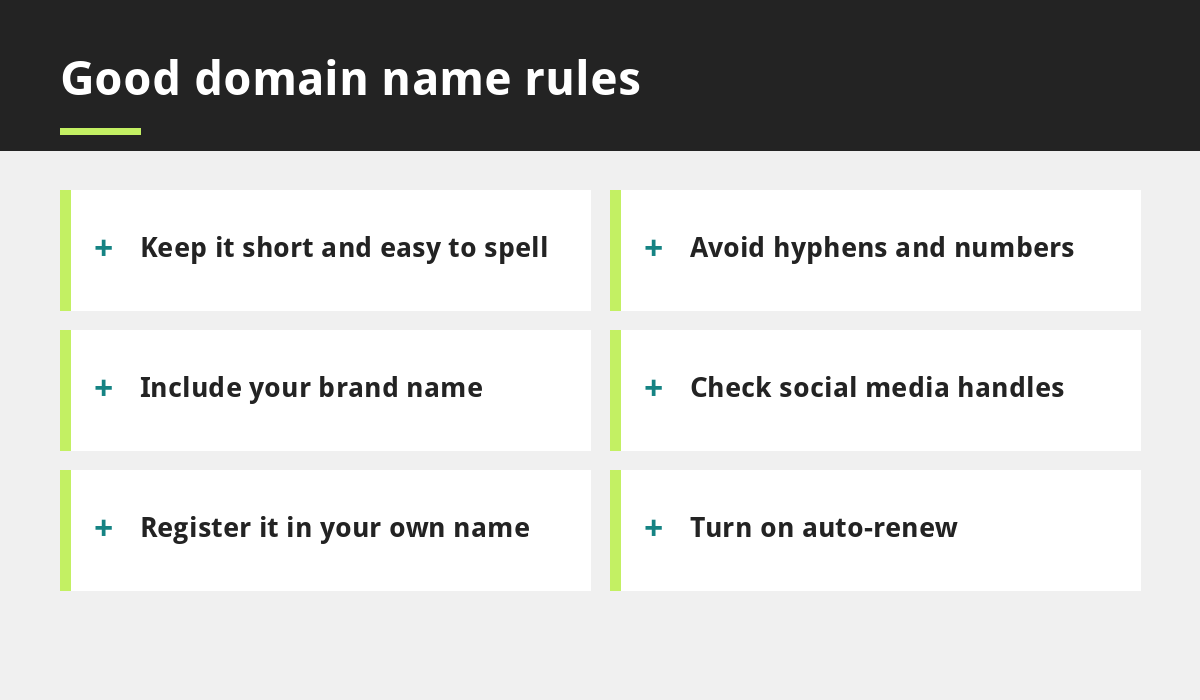
- Register the domain in your own business’s name and keep the login details safe.
- Turn on auto-renew so you never lose your domain by accident.
What is a domain name?
A domain name is the text people type to reach your website, such as yourbusiness.co.uk. You do not buy it forever. You register it for a set period, usually one year or more, and renew it to keep it. It is separate from your hosting, which is where your website files live, although many providers sell both together.
.co.uk vs .com vs other endings
- .co.uk: widely recognised in the UK and a good fit for businesses serving British customers.
- .uk: a shorter UK ending that is also available, and some businesses register it alongside .co.uk.
- .com: the most familiar ending worldwide and useful if you plan to sell internationally.
- New endings such as .shop or .london: can work for specific cases, but may be less familiar to some customers.
If your business serves a local or UK audience, .co.uk is usually a sensible first choice. If you can, register the closest alternatives too, so a competitor cannot take them.
How to choose a good domain name
- Keep it short. Fewer characters mean fewer typing mistakes.
- Make it easy to say. Say it out loud to a friend. If they ask how to spell it, simplify it.
- Use your business name. It makes branding simple and consistent.
- Avoid hyphens and numbers. They are easy to forget or mishear.
- Avoid awkward word combinations. Check that joined words do not accidentally spell something unintended.
- Think long term. Do not tie your name to one service or one town if you may expand.
If you are still working on your business name, our post on building a strong brand identity may help.
Should your domain include keywords?
A keyword in a domain, such as a trade or town name, can help customers understand what you do, but it is not a magic ranking trick. Search engines look at the quality of your website and content far more than the words in your address. A clear, brandable name is usually a better long-term choice than a long keyword-heavy one.
Checks to make before you register
- Search for the name on Google to see who else uses it.
- Check that the name is not too close to another business or registered trade mark, to avoid disputes.
- Look for matching social media usernames.
- Confirm the business name works if you use it as an email address.
Make sure you own your domain
This is the most important step. The domain should be registered in your name or your company name, with your own email address as the contact. Some providers register domains in their own name and you only have the right to use them. If you later fall out, you could lose your web address. Ask who the registrant is, keep your login details and consider using a registrar account that you control. Our guide to affordable website red flags includes this question for a reason.
Renewals, costs and auto-renew
UK domain names are commonly priced at around £8 to £15 a year, although prices vary by provider and ending, and renewal prices can differ from the first-year offer. Turn on auto-renew, keep your payment details current and diarise the expiry date. Losing a domain by accident is stressful and can take your website and email offline.
Use your domain for email
An email address like hello@yourbusiness.co.uk looks far more professional than a free webmail address and builds trust with customers. Most hosting and email providers can set this up for you.
Connect your domain to a website
Once registered, your domain needs to point to your hosting or website platform. If you use a platform like WordPress, Wix or Squarespace, the connection is usually simple. Compare them in our guide to WordPress vs Wix vs Squarespace, or ask our web development team to handle it.
Common domain name mistakes
- Letting a web designer register it in their own name.
- Choosing a long or hard-to-spell name.
- Forgetting to renew.
- Using hyphens and numbers.
- Registering a name too close to a competitor.
Frequently asked questions
Is .co.uk better than .com for a UK business?
For a UK-focused business, .co.uk is a trusted and natural choice. A .com is useful if you plan to serve customers worldwide. Registering both can protect your brand.
How much does a domain name cost in the UK?
UK domain names are commonly priced at around £8 to £15 a year, but prices vary by provider and the renewal price may differ from the first-year price.
Can I change my domain name later?
Yes, but it takes careful planning to avoid losing traffic and confusing customers. It is much better to choose a good name from the start.
Who should own my domain name?
You or your business should. Make sure you are the registrant and that you can log in to the registrar account.
Do I need a domain name to have a website?
You can use a free subdomain on some platforms, but a domain of your own looks more professional, is easier to remember and keeps you in control.
Final thoughts
The right domain name for a UK business is short, memorable and fully under your control. Choose something simple, think about .co.uk or .com, avoid hyphens and numbers, register it in your own name and turn on auto-renew. Do those things and your web address will serve your business for years.
If you need help choosing or registering one, get in touch with our team.
Related reading
- WordPress vs Wix vs Squarespace for UK Small Businesses
- Affordable Website UK: Red Flags to Check Before You Pay
- Small Business Website Checklist
- Building a Strong Brand Identity for Your Online Business
Launch offer for UK small businesses. Get a professional website for just £299 a year. Only the first 20 customers, for restaurants, small clinics and small businesses.