By the Vertexweb team. Last reviewed 4 October 2026.
Searching for a affordable website in the UK is usually the first step for small business owners who need to get online without a big upfront bill. It makes sense. A restaurant, clinic, salon or local shop already has plenty of costs to cover, and a website can feel like one more expense. But the lowest quote is not always the lowest cost over time. Some low-price websites are genuinely good value. Others leave you paying again for hosting, changes, support or even a rebuild.
This guide explains what an affordable website really includes, what UK small businesses typically pay, the red flags to watch for and the exact questions to ask before you hand over any money. By the end, you will be able to compare offers with confidence and choose a website that actually helps your business.
Key takeaways
- A low price does not have to mean poor quality, but you must see the full cost for the whole year, including renewal.
- Check who owns your domain name and your content before you pay anything.
- Always ask whether the price includes VAT, hosting, security and support.
- A simple, mobile-friendly site with clear contact details can be enough for many local businesses.
- Compare like with like: ask every provider for the same list of inclusions.
What counts as an affordable website?
There is no official definition, but in practice an affordable website is any site that costs noticeably less than a typical custom-built agency project. UK pricing guides place professionally built small business sites at roughly £1,000 to £5,000 or more, while basic builders and template sites can cost from a few pounds a month. Anything well below the typical range is likely to be template-based, simplified or heavily packaged.
That is not a bad thing by itself. A good template can look professional, load quickly and do exactly what a local business needs. The real question is not how low the price is. The question is whether the price covers everything you need, and whether you can see the full cost in advance.
What do UK small businesses typically pay?
Pricing varies widely, so treat any range as a rough guide rather than a promise. Guides published by UK web agencies and business sites commonly describe the following:
- DIY website builders: from a few pounds a month, but you do all the work yourself.
- Freelancers: a basic five to ten page brochure site is often quoted from a few hundred pounds up to a few thousand.
- Small agencies: standard business websites often start in the low thousands and rise with complexity.
- E-commerce and custom builds: significantly higher, because of product catalogues, payments and special features.
Then there are the running costs. A .co.uk or .com domain name is commonly priced at around £8 to £15 a year. Basic SSL security certificates are now often included free with good hosting. Hosting itself can cost from a few pounds a month, and some agencies add monthly maintenance plans on top. Many software platforms also show prices before VAT, so ask whether 20% will be added at checkout.
For a deeper breakdown of pricing, read our guide on how much a business website costs in the UK.
Hidden costs to look out for
The advertised price is only part of the story. These are the extras that most often catch small business owners by surprise.
Hosting and renewal fees
Some offers include the first year free or discounted, then jump sharply at renewal. Ask what you will pay in year two, not just year one.
Charges for every change
If a simple edit to your opening hours or menu costs extra each time, small changes can add up quickly. Ask whether you can update the content yourself.
Extra pages and features
A low price may cover only a few pages. Booking forms, galleries, maps and extra languages are sometimes sold separately.
Support and security
Websites need updates and backups. Check whether these are included, and who fixes things if the site goes down.
Domain transfer fees
If you decide to leave, some providers charge to release your domain or make it difficult to move your site. This leads neatly to the next section.
Red flags in an affordable website offer
You do not own your domain name
Your domain name is your business address online. It should be registered in your name or your company name, not the provider’s.
No clear list of what is included
If the offer is vague about pages, hosting, support and updates, assume the gaps will cost extra later.
No examples of real work
A trustworthy provider can show you websites they have built. If you cannot see any real examples, be careful.
Pressure to pay immediately
Genuine limited offers exist, but you should still have time to read the details and ask questions.
No mobile design or SEO basics
Most local customers visit on their phones. Our post on why your business needs a mobile-first website explains why this matters. Basic search engine setup, such as page titles and descriptions, should also be part of the build.
Guaranteed number one rankings
No one can honestly guarantee a top Google position. Real search engine optimisation takes time and effort.
Questions to ask before you pay
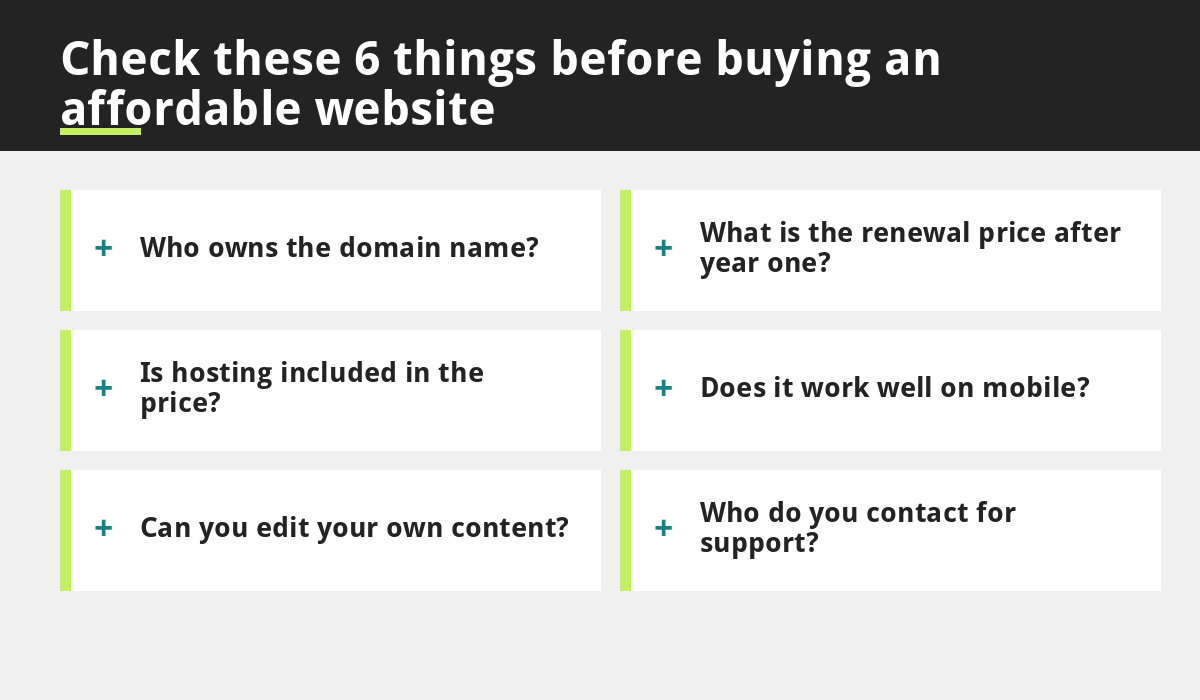
Before you agree to anything, ask each provider the same set of questions and write down the answers:
- What exactly is included in the price, and what costs extra?
- What is the total cost in year one and in year two?
- Is the price shown with or without VAT?
- Do I own my domain name, my content and my images?
- Will the website work well on phones and tablets?
- Can I update the text myself, or do I need to pay you?
- Who do I contact if something breaks, and how quickly will you reply?
DIY builder, freelancer or agency: which is right?
A DIY builder suits owners who enjoy tinkering and have time to spare. It is low-cost, but the result depends on your design skills, and you are responsible for everything from layout to search visibility.
A freelancer can offer personal service and fair pricing. The risk is availability: if they are busy or move on, you may struggle to get help.
An agency usually brings a team that covers design, development and marketing. This costs more, but you get broader support. Our web development service is built around this approach, while keeping prices realistic for small businesses.
When a low price is genuinely good value
A low-cost package can be exactly right for a restaurant, clinic, salon or local shop that mainly needs a credible online home. Your visitors want to know who you are, what you offer, where you are and how to contact you. A clean, fast, mobile-friendly site with those basics can do a lot of work for you.
A low price is a good sign when the provider is open about what is included, you keep ownership of your domain and content, the renewal price is stated clearly and you can see examples of similar businesses. Avoiding the common layout problems in our guide to five website design mistakes that cost you customers will also help any website perform better.
How to compare website quotes properly
- Ask for a written breakdown. Request the same information from every provider.
- Calculate the two-year cost. Add build, hosting, domain, support and renewal.
- Check the inclusions. Count pages, features, forms and search setup.
- Look at their work. Visit live examples on your phone.
- Read reviews and ask for references. Real customer feedback matters.
- Confirm ownership and exit terms. Make sure you can leave with your site and domain.
Our £299 a year launch offer
At Vertexweb, we are running a launch offer for UK restaurants, small clinics and small businesses: a professional website for £299 a year, available to the first 20 customers only. You can read the details on our offer page, or contact us with any questions before you decide. We encourage you to ask us the same questions listed above.
Frequently asked questions
How much should a small business website cost in the UK?
It depends on the type of site. UK pricing guides commonly quote a few hundred pounds up to a few thousand for a basic brochure website, with larger or custom projects costing more. Always ask for the total cost across at least two years, including hosting, domain and VAT.
Is an affordable website bad for SEO?
Not necessarily. What matters is whether the site loads quickly, works on mobile, has clear page titles and content, and is set up correctly. A simple, well-built site can perform well in search results.
Do I need to pay for an SSL certificate?
Often not. Many good hosting providers include a basic SSL certificate at no extra charge, which gives your site the secure padlock. Check that it is included before you buy.
Can I move my website to another provider later?
You should be able to, but only if you own your domain and content. Ask about this before you sign up, and get the answer in writing.
Is a free website builder enough for my business?
It can work as a starting point, but free plans often show the builder’s branding, limit features and use a subdomain rather than your own domain name. Most businesses benefit from their own domain name.
Final thoughts
A affordable website in the UK can be a smart decision when you know what you are paying for. The goal is not the lowest price, but the best value: a website that looks professional, works on phones, is easy to find and does not surprise you with hidden costs. Use the questions in this guide to compare offers, check who owns your domain and always ask what happens at renewal.
If you would like help choosing the right option, our team is happy to talk it through on our contact page.
Related reading
- Restaurant Website Design UK: What Every Restaurant Website Needs
- Small Business Website Checklist: 8 Things to Check Before You Launch
- Website vs Google Business Profile vs Social Media
- How Much Does a Business Website Cost in the UK?
Launch offer for UK small businesses. Get a professional website for just £299 a year. Only the first 20 customers, for restaurants, small clinics and small businesses.