By the Vertexweb team. Last reviewed 4 October 2026.
When someone is hungry and searching on their phone, they usually compare a handful of places in seconds. Good restaurant website design in the UK makes sure your restaurant is the one they choose. A restaurant website has one main job: turn curiosity into a booking, an order or a visit. Everything on the site should help a hungry visitor find your menu, check your opening hours and book a table with as few taps as possible.
In this guide, we explain which pages and features a UK restaurant website needs, how to handle menus and allergens, how to take bookings, how to show up in local searches and which mistakes to avoid. It is written for owners of restaurants, cafes and takeaways who want a practical plan rather than technical jargon.
Key takeaways
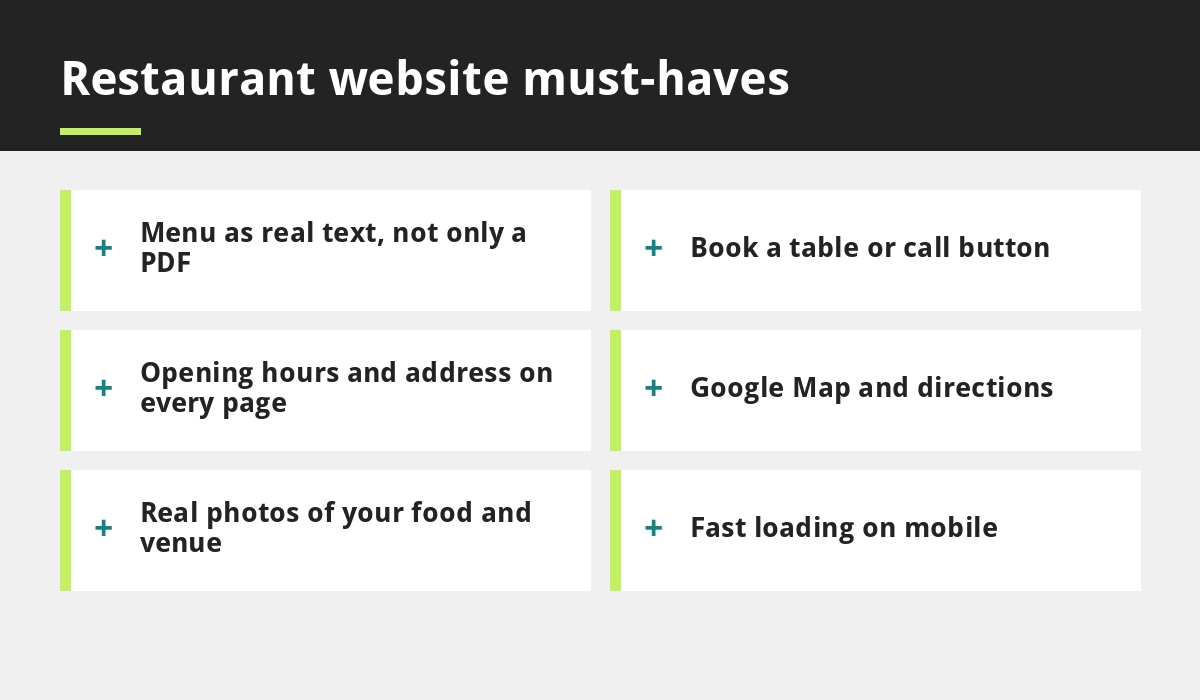
- Your menu should be real text on a page, not only a PDF, so it works on phones and in search.
- Make booking, ordering or calling obvious from the first screen.
- Show opening hours, address, phone number and map on every page or in the footer.
- Local SEO, including a complete Google Business Profile, brings nearby customers to your site.
- Real photos, fast loading and a mobile-first layout matter more than fancy effects.
Why your restaurant needs its own website
Many restaurants rely on social media, delivery apps and review platforms. These are useful, but they are not yours. Delivery and listing platforms often charge fees, social posts disappear quickly and you cannot fully control how your business appears. A website is the one place online where you decide the message, the menu, the photos and the booking process.
Your website also helps search engines understand who you are. When a diner searches for a Thai restaurant, a Sunday roast or a family-friendly cafe in your town, a well-built website with clear information gives Google something solid to show.
If you are weighing up where to put your effort, our article on website vs Google Business Profile vs social media compares websites, Google Business Profiles and social media.
The essential pages for a restaurant website
You do not need dozens of pages. For most restaurants, a handful of clear pages is enough.
- Homepage: a short introduction, a strong photo, your booking or order button, and key details like hours and location.
- Menu: dishes, drinks and prices, organised in clear sections.
- Book a table or contact: a form, booking link or phone number, plus a map.
- About: your story, your team and what makes your food special.
- Events or private hire: if you take group bookings, parties or special events.
Keep navigation simple, with no more than five or six items in the main menu. Visitors should never have to guess where to click.
Menus, prices and allergen information
The menu is often the most visited page on a restaurant website, so make it excellent. Publish it as text on the page so it loads quickly on phones and can be read by search engines. A PDF can still be offered as a download for printing, but it should not be your only version, because PDFs are awkward to read on small screens.
Include prices, describe dishes in one clear line and mark vegetarian, vegan or gluten-free options. UK food businesses must tell customers about the 14 allergens named in food law, and the Food Standards Agency’s best-practice guidance for England, Wales and Northern Ireland encourages written allergen information that is easy to find, supported by a conversation with staff. Scotland has its own guidance, so check the rules for where you operate.
Booking, ordering and calls to action
Decide what action matters most, then make it impossible to miss. Use clear button labels such as Book a table, Order online or Call us, and place them at the top of the homepage and in the header.
Your site can link to a booking system you already use, include an embedded booking widget or offer a simple enquiry form if you are a smaller venue. The best option is the one your team can manage easily during a busy service. Fewer steps usually means more bookings.
Local SEO for restaurants
Most restaurant searches are local, such as “brunch near me” or “Italian restaurant in Leeds”. To appear in those results, focus on the basics:
- Claim and complete your Google Business Profile with hours, photos, menu link and categories.
- Keep your business name, address and phone number identical everywhere online.
- Mention your town and neighbourhood naturally on your homepage and contact page.
- Ask happy customers for reviews and reply to every review.
- Add a Google Map to your contact page.
Our guide on how local SEO helps UK businesses win nearby customers explains each step in more detail, and our SEO service can set it all up for you.
Photos, design and atmosphere
People choose restaurants with their eyes. Use real photos of your dishes, your dining room and your team instead of generic stock images. Good natural light and a clean background make a big difference, and a modern phone can take excellent food photos.
Your design should match your atmosphere. A relaxed neighbourhood cafe and a fine dining restaurant should feel different, but both need easy-to-read text and plenty of contrast. Our graphic design service can help with logos, menus and branding that tie everything together.
Mobile-first design and speed
Most people look up restaurants on their phones, often while on the move. That means large tap targets, short pages and fast loading images. Compress photos before uploading, avoid heavy videos on the homepage and test the site on a real phone. Read more in why your business needs a mobile-first website.
Reviews, social proof and fresh content
Before choosing, diners want reassurance that others have enjoyed your food. Show a few genuine reviews on your site and link to your Google or social profiles. Keep your website fresh with seasonal menus, special events and news. If you post regularly on social media, our social media marketing team can help it work alongside your website, and our guide to writing blog posts that rank on Google shows how to turn news into search traffic.
Common restaurant website mistakes
- A menu that exists only as a hard-to-read PDF.
- Opening hours that are out of date.
- A booking button that is hidden or does not work on mobile.
- Large, slow photos that make pages crawl.
- No map or directions.
- No clear way to ask about allergens.
You can avoid most of these by running through our website launch checklist before you go live.
Budget and getting started
A restaurant website does not have to be expensive. A simple, well-built site with a menu, booking route, photos and contact details can do the job. Whatever you choose, check what is included, who owns your domain and what the renewal price is. Our guide on affordable websites and the red flags to avoid lists the questions to ask.
Frequently asked questions
Do restaurants still need a website if they are on Instagram?
Yes. Social media is great for visibility, but a website gives you control over your menu, bookings and information, and gives search engines a clear source of truth about your restaurant.
How many pages does a restaurant website need?
Most restaurants do well with five or six pages: home, menu, booking or contact, about and, if relevant, events or private hire.
Should I add online ordering to my website?
If you offer takeaway or delivery, yes. You can link to an ordering system or use a simple order form. Make sure the process works smoothly on a phone.
How do I appear in near me searches?
Complete your Google Business Profile, keep your details consistent online, collect reviews and make sure your website clearly states your location and what you serve.
How often should I update my menu online?
Update it whenever dishes or prices change. Outdated menus frustrate customers and can lead to complaints, especially around allergens.
Final thoughts
The best restaurant website design in the UK is simple, fast and focused on the guest. Show a clear menu, make booking easy, display your hours and location, use real photos and set up your local search presence. Do these things well and your website becomes a hardworking part of your team, filling tables while you focus on the food.
If you would like help building one, get in touch with our team.
Sources and further reading
Related reading
- Affordable Website UK: Red Flags to Check Before You Pay
- Website vs Google Business Profile vs Social Media
- Small Business Website Checklist
- How Local SEO Helps UK Businesses Win Customers Nearby
Launch offer for UK small businesses. Get a professional website for just £299 a year. Only the first 20 customers, for restaurants, small clinics and small businesses.