By the Vertexweb team. Last reviewed 4 October 2026.
Local SEO helps nearby customers find your business when they search on Google or Google Maps. It is how a restaurant appears for dinner near me, a clinic for physiotherapy in your town or a plumber for emergency plumber. For small UK businesses it is often the most affordable way to reach people who are ready to buy, because they are searching for what you offer, close to where you are.
This guide explains how local search works, the practical steps that matter most, how to measure progress and the mistakes that hold small businesses back. It is written for owners, not specialists, so you can start applying it this week.
Key takeaways
- Google generally looks at relevance, distance and prominence when choosing local results.
- A complete, accurate Google Business Profile is the single most important local SEO asset.
- Consistent business details, helpful location and service pages and honest reviews all strengthen your visibility.
- A fast, mobile-friendly website turns local searchers into customers.
- Local SEO builds slowly. Track enquiries, calls and direction requests, not just rankings.
What is local SEO?
Local SEO is the work of making your business easier to find in searches with a local intent. These include searches that contain a place name, such as barber in Leeds, and searches where Google understands that the person wants something nearby, such as pharmacy open now. Results often include a map and a short list of businesses, followed by regular website listings.
For businesses with a shop, restaurant, clinic or studio, and for service businesses that travel to customers, being visible in those results can bring calls, direction requests, bookings and walk-ins.
How Google chooses local results
Google has explained that local results are mainly based on three factors:
- Relevance: how well your business profile and website match what the person searched for.
- Distance: how far your business is from the searcher, or from the location they mention.
- Prominence: how well known your business is, based on information such as reviews, links, mentions and your presence across the web.
You cannot change where you are, but you can improve relevance with accurate, detailed information and prominence with trustworthy reviews, a quality website and consistent details online.
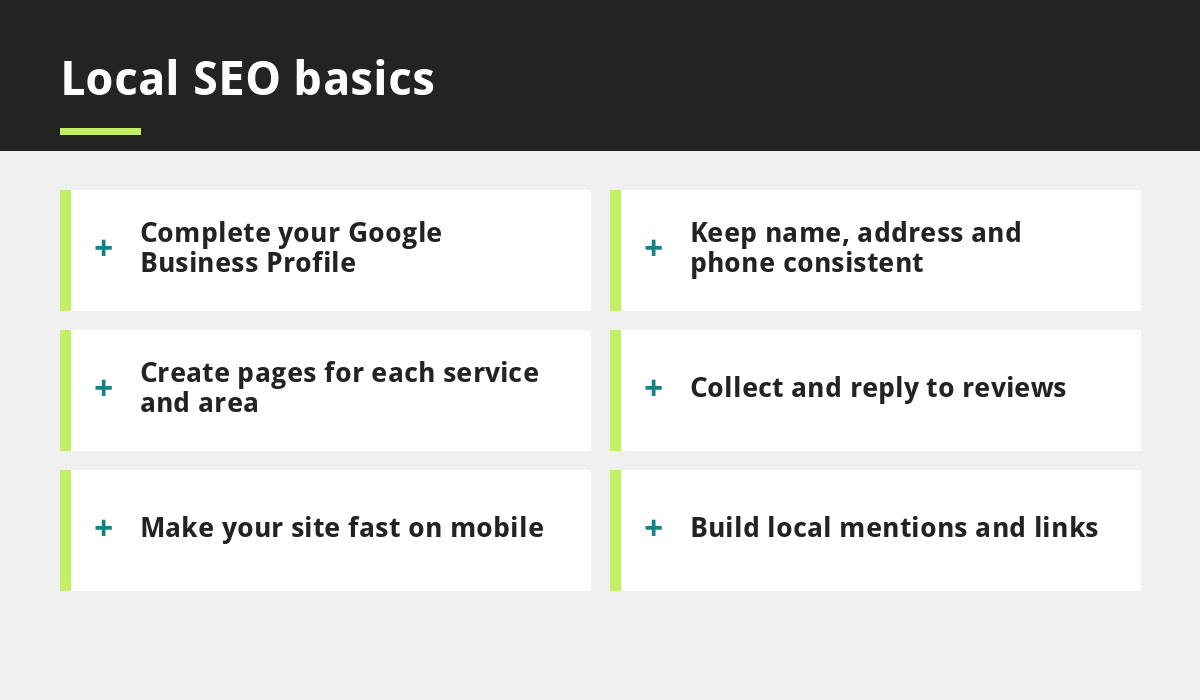
Step 1: Set up your Google Business Profile
Your Google Business Profile is the listing that appears in Google Search and Maps. Claim and verify it, choose accurate categories, add opening hours, services, photos and a link to your website, and keep everything up to date. Follow Google’s own rules for representing your business accurately, including using your real trading name. Our full walkthrough, Google Business Profile optimisation: a step-by-step guide, covers each setting.
Step 2: Keep your business details consistent
Your business name, address and phone number should match across your website, Google profile, social media and directory listings. Inconsistent details confuse both customers and search engines. Make one master copy of your details and use it everywhere. If you move or change number, update all listings, not just your website.
Step 3: Build a website that supports local search
Your website should make it obvious what you do and where you do it. Put your address, phone number and opening hours on the contact page and in the footer, embed a map and mention the towns or areas you serve in natural language on your homepage. Create a separate page for each main service, with clear, original descriptions. If you serve several areas, add genuinely useful pages for each main one, rather than dozens of near-identical copies.
Examples of sector-specific pages that work well include our guides for restaurants, clinics, salons and tradespeople.
Step 4: Earn honest reviews
Reviews influence both customer decisions and local prominence. Ask satisfied customers for feedback, reply to every review and never buy or fake reviews. UK consumer law and Google’s own policies take a firm line on this, which we explain in our guide to getting more Google reviews.
Step 5: Build local mentions and links
Mentions of your business on trusted local websites help show that you are a real, established business. Good sources include your local chamber of commerce, business associations, community sponsorships, supplier or partner pages and local news. Quality matters more than quantity. Avoid paying for large bundles of low-quality directory links.
Step 6: Publish helpful local content
Content that answers local questions can bring in extra visitors. A restaurant might write about seasonal menus or events, a clinic about what to expect at a first appointment, a trade business about common problems in local homes. Keep it practical and honest. Our guide on writing blog posts that rank on Google explains how to plan each post.
Step 7: Make your site fast on mobile
Most local searches happen on phones, and visitors expect to call, get directions or book in a couple of taps. Use large buttons, readable text and compressed images. See why your business needs a mobile-first website and how to speed up your small business website.
How to measure local SEO
Do not rely on rankings alone, because results vary by location and device. Track the outcomes that matter: phone calls, direction requests and website clicks from your Google Business Profile, form enquiries and bookings, and organic visits to your key pages in Google Analytics. Compare month to month and note what you changed.
Common local SEO mistakes
- Adding keywords or locations to your business name, which breaks Google’s guidelines.
- Using a virtual office or an address where you do not really operate.
- Leaving old opening hours or phone numbers online.
- Ignoring reviews, especially negative ones.
- Publishing copied or near-identical location pages.
- Expecting instant results.
Common questions
How long does local SEO take?
Some improvements, such as correcting your profile, can help within weeks. Building stronger prominence through reviews, content and links is gradual and usually takes months.
Do I need a website for local SEO?
You can appear in local results with a Google Business Profile alone, but a good website gives Google more information and gives customers a reason to choose you.
Is local SEO different for service-area businesses?
Yes, slightly. If you travel to customers, you can set service areas on your profile and may hide your address. You should still describe those areas clearly on your website.
Final thoughts
Local SEO rewards businesses that are accurate, helpful and consistent. Set up your Google Business Profile properly, keep your details aligned everywhere, build a fast and clear website, earn honest reviews and publish useful local content. Measure real enquiries, and improve a little each month.
If you would like help, see our SEO services or contact the team.
Sources and further reading
Related reading
- Google Business Profile Optimisation Guide
- How to Get More Google Reviews
- Website vs Google Business Profile vs Social Media
- Google Ads vs SEO
Launch offer for UK small businesses. Get a professional website for just £299 a year. Only the first 20 customers, for restaurants, small clinics and small businesses.