By the Vertexweb team. Last reviewed 4 October 2026.
Google Ads gives you fast, paid visibility, while SEO builds free, lasting visibility more slowly. Both put your business in front of people who are searching, but they differ in speed, cost, control and long-term value. For a small business, the better first step depends on your goals, budget and how quickly you need enquiries.
This guide compares the two in plain English, explains when to start with each, how they work together and the mistakes to avoid, so you can spend your marketing budget wisely.
Key takeaways
- Google Ads can bring visitors quickly, but you pay for each click and traffic stops when spending stops.
- SEO takes longer but can deliver steady, lasting visibility without paying per click.
- Ads suit urgent goals, new launches and testing demand. SEO suits long-term growth.
- Many small businesses benefit from a modest mix of both.
- Track enquiries and cost per lead, not just clicks or rankings.
How each one works
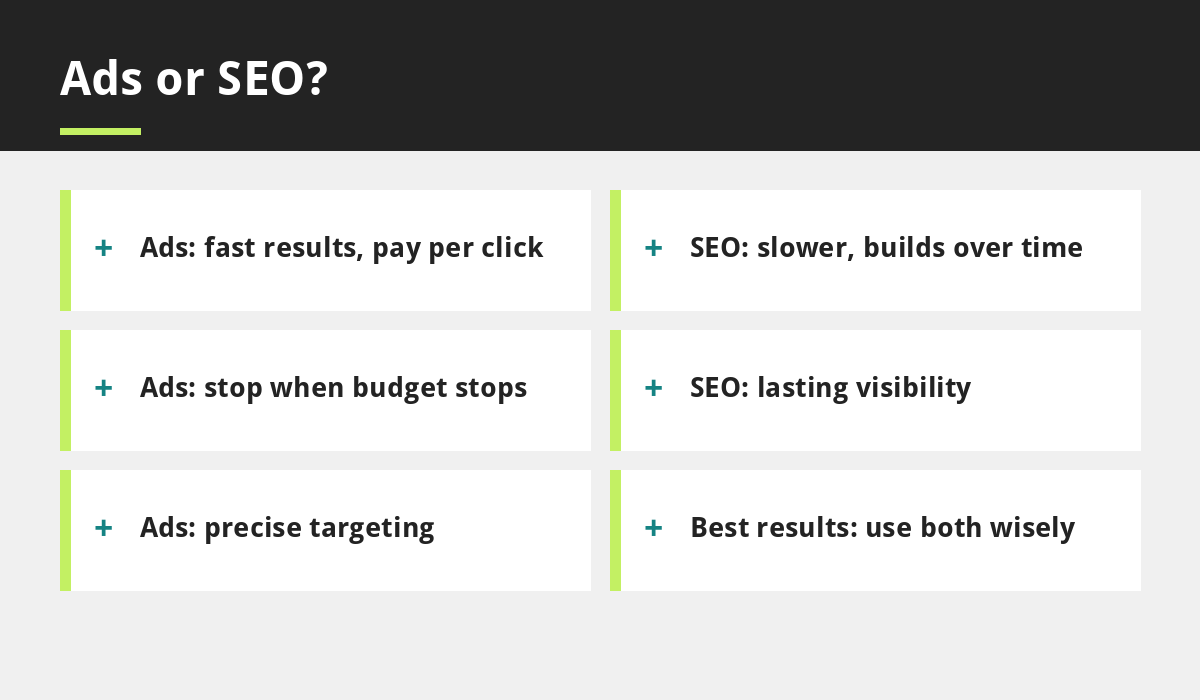
Google Ads lets you bid to show adverts for chosen searches. You usually pay when someone clicks. SEO means improving your website, content and online presence so that your pages appear in the unpaid results and in local map results. You do not pay Google for those clicks, but you invest time, expertise or agency fees to earn them.
Speed of results
Ads can start sending visitors as soon as a campaign is approved and live, which makes them useful for launches, seasonal offers or testing demand. SEO usually takes months to build, because search engines need time to find, understand and trust your pages and because competitors are also improving.
Cost and value over time
With ads, costs depend on how competitive your keywords are and how well your adverts and landing pages perform. When you stop paying, the traffic stops. With SEO, the early months may bring little, but well-built pages and a good reputation can keep bringing visitors with no cost per click. Both need a good website, which is why basics such as speed and mobile design matter. See how to speed up your website and why mobile-first matters.
Control and targeting
Ads give precise control: choose keywords, locations, times of day, budgets and messages, and change them quickly. SEO gives less direct control, since rankings depend on many factors outside your hands, but it builds an asset that you own.
What about local businesses?
Local businesses have an extra free option: a well-optimised Google Business Profile, which can appear in local map results and bring calls and direction requests. Start there, using our guides on Google Business Profile optimisation and local SEO, and consider ads to add visibility for high-value services.
When to start with ads, and when with SEO
- Start with ads if you need enquiries soon, have a clear offer, have a website that converts and can test a modest budget.
- Start with SEO if you want sustainable growth, have time to build, serve a clear local or niche audience and can create helpful content.
- Do both if you can fund ads for quick wins while building organic visibility.
How they work together
Ads can reveal which searches and messages bring customers, and those insights can guide your SEO content. SEO pages can also improve landing page quality for ads. Over time, strong organic presence can reduce how much you rely on paid clicks. Our pay per click and SEO teams work side by side for this reason.
Measure results properly
For ads, track cost per enquiry or booking, not just clicks. For SEO, track organic enquiries, calls from your profile, and visits to your key pages. Always connect results to revenue where you can, so you know what is genuinely working.
Common mistakes
- Sending ad traffic to a slow or confusing page.
- Choosing very broad keywords that waste budget.
- Expecting SEO results in a few weeks.
- Ignoring tracking, so you cannot tell what works.
- Believing anyone who guarantees a number one ranking.
How to think about budget
Rather than starting with an amount, start with a goal, such as ten extra enquiries a month, and work backwards. Estimate what an enquiry is worth, what share become customers and how much you can afford to pay to win one. For ads, run a small test, measure the cost per enquiry and scale only if the numbers make sense. For SEO, budget for ongoing time and content rather than a one-off job, and judge it over months. Whichever route you choose, a fast, clear website is the foundation that makes every pound work harder.
An illustration: a local clinic’s first six months
This is a simple example, not real results. Imagine a small clinic that needs new patients soon. It starts with a modest ads test for its most valuable treatment and sends clicks to a clear, fast landing page with a simple booking form. At the same time it completes its Google Business Profile, publishes helpful treatment pages and begins collecting honest reviews. After a few months, the ads data shows which messages work, the organic pages begin to appear in searches and the clinic can decide how much to keep spending on ads. The clinic still tracks enquiries and bookings throughout.
Common questions
Is SEO better than Google Ads?
Neither is better in every case. Ads are faster and more controllable, while SEO is slower but can bring lasting visibility. The right choice depends on your goals and budget.
Can I run Google Ads and SEO together?
Yes. Many businesses do. Ads can bring quick visitors and test messages while SEO builds long-term visibility.
How much should a small business spend on Google Ads?
There is no standard amount. Start with a modest, test-and-learn budget, track cost per enquiry and increase only when results justify it.
Final thoughts
Google Ads and SEO are partners, not rivals. Use ads when you need speed and control, SEO when you want steady, lasting growth, and a sensible mix when you can. Build on a fast, clear website and measure real enquiries.
For advice tailored to your business, contact our team.
Related reading
- How Local SEO Helps UK Businesses Win Customers Nearby
- Google Business Profile Optimisation Guide
- How to Speed Up Your Small Business Website
- Why Content Marketing Is Still the Backbone of Online Growth
Launch offer for UK small businesses. Get a professional website for just £299 a year. Only the first 20 customers, for restaurants, small clinics and small businesses.