
By the Vertexweb team. Last reviewed 4 October 2026.
Do small businesses need a website when they already have a Facebook page, an Instagram account or a Google Business Profile? It is one of the most common questions we hear from restaurants, clinics, shops and trades. The short answer is that those channels are useful, but a website gives you something none of them can: a place online that you fully own and control.
For the wider case for a professional website, see why UK small businesses need website design in 2026. In this guide, we compare websites, Google Business Profiles and social media, explain what each does best, show how they work together and give you a simple plan for where to start if you have a small budget.
Key takeaways
- A website is the only online space you fully own and control.
- A Google Business Profile is free and excellent for local map results, but it has limited space and control.
- Social media builds familiarity and sends quick updates, but posts disappear quickly and platform rules change.
- The three work best together, with your website at the centre.
- You can start small: a simple site with clear contact details is enough for most local businesses.
The short answer
Yes, most small businesses benefit from having a website, even a simple one. If customers cannot find clear, trustworthy information about you in one place, many will move on to a competitor who has it. Your website is where people confirm you are real, see what you offer and decide to contact you.
That does not mean you should abandon social media or your Google profile. It means you should treat them as parts of one system, with your website as the hub.
What a website does best
A website gives you full control over layout, message, prices, menus, services and the way people contact or book. You choose what to show and how to show it. It is also the place where search engines can learn the most about your business, because you can give them detailed, well-organised information.
Importantly, your website cannot be switched off by a platform change. Social networks can alter their algorithms, hide your posts or change their terms at any time. Your website, with your own domain name, stays yours. To pick a provider wisely, read our guide on cheap websites and the red flags to check.
What Google Business Profile does best
A Google Business Profile lets you appear in local search and map results with your opening hours, photos, reviews, phone number and directions. It is free and especially important for businesses that serve a local area, such as restaurants, clinics, salons and trades.
Its limits are space and control. You cannot tell your full story, show a detailed menu or service list in the way a website can. It works best when it links to a good website. Our guide to local SEO for UK businesses explains how the two support each other.
What social media does best
Social media helps people get to know your business. It is great for sharing news, offers, behind-the-scenes moments and customer stories, and for staying visible to people who already follow you. The weakness is that posts are short-lived, reach can change without warning and followers do not always turn into customers.
If you want to use social media effectively, start with our beginner’s guide to social media marketing for small businesses, or ask about our social media marketing service.
Website vs Google Business Profile vs social media
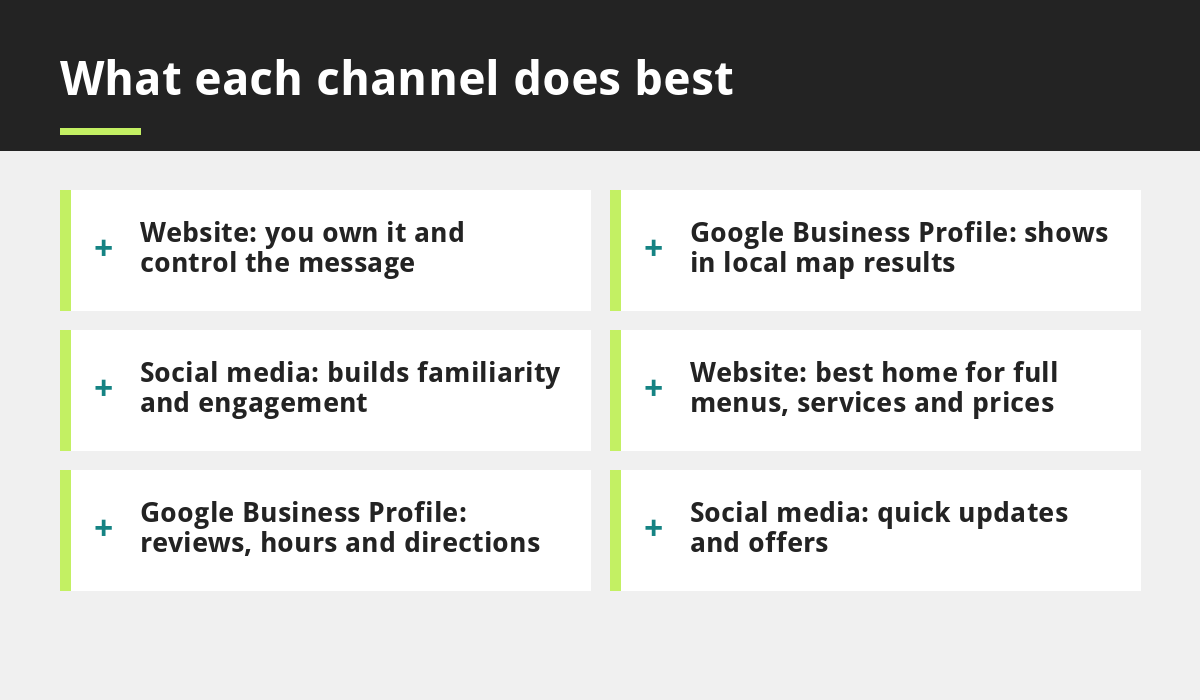
Think of it like a shop. Your Google Business Profile is the sign on the street that helps people find you. Social media is the window display that shows what is new. Your website is the shop itself, where people learn everything and decide to buy or book.
How they work together
A typical customer journey might look like this: someone sees your social post, searches your business name on Google, finds your Business Profile with good reviews and taps through to your website to check the menu, fees or services, then books. If any link in that chain is missing or weak, you can lose the customer. A well-built website holds the chain together.
Can you start without a website?
If your budget is extremely tight, you can begin with a free Google Business Profile and one active social profile. That is better than nothing. But treat it as a starting point. As soon as you can, add a simple website so that you control your information, show up better in search and can collect enquiries in your own way.
What a small business website really needs
- A clear explanation of what you do and who it is for.
- Your location, opening hours and contact details.
- Services, menu or prices in plain language.
- A fast, mobile-friendly design.
- A simple way to enquire, call or book.
- Basic search engine setup, such as page titles and descriptions.
That is enough for most local businesses. See our web development services, or read why UK small businesses need website design in 2026.
A simple starter plan
- Claim your Google Business Profile and fill it in completely.
- Choose a domain name that is short and easy to spell.
- Build a simple website with the basics above.
- Link everything together so your profile, social pages and site point to each other.
- Check before launch using our website launch checklist.
Mistakes to avoid
- Relying only on a social page that you do not control.
- Letting your Google profile go out of date.
- Having a website that is slow or hard to use on a phone.
- Using different business details on different platforms.
For more on avoiding design problems, see five website design mistakes that cost you customers.
Frequently asked questions
Is a Facebook page enough for a small business?
It is a good start, but not enough on its own. You do not control the platform, and many customers expect a website with clear information and an easy way to book or enquire.
Is a Google Business Profile enough?
It is essential for local businesses, but it has limited space and control. It works best when linked to a website that explains your services in more detail.
How much does a small business website cost?
Costs vary widely, from a few pounds a month for DIY builders to a few thousand pounds for a custom build. Always ask what is included, who owns the domain and what the renewal price is.
How long does it take to build a simple website?
A simple small business website can often be built in a few weeks, depending on how quickly you provide text, photos and decisions.
Do sole traders and tradespeople need a website?
Usually yes. Even a simple site with your services, area covered, photos of your work and contact details helps customers trust you and find you in search.
Final thoughts
So, do small businesses need a website? In most cases, yes. A website gives you ownership, credibility and control that social media and directory listings cannot match. Use your Google Business Profile to be found locally, social media to stay visible and your website to explain, convince and convert. Start simple, keep your details consistent and improve as you grow.
If you would like help choosing the right option for your business, get in touch.
Related reading
- Cheap Website UK: Red Flags to Check Before You Pay
- Restaurant Website Design UK
- Clinic Website Design UK
- Small Business Website Checklist
Launch offer for UK small businesses. Get a professional website for just £299 a year. Only the first 20 customers, for restaurants, small clinics and small businesses.