By the Vertexweb team. Last reviewed 4 October 2026.
Before choosing a restaurant, clinic, salon or tradesperson, most people check the reviews. A strong set of recent, honest ratings can be the difference between a customer calling you and scrolling past. If you want to get more Google reviews, the good news is that you do not need tricks. You need a simple routine, a direct link and the habit of asking at the right moment.
This guide explains why reviews matter, what Google and UK law say you must not do, exactly when and how to ask, how to reply to praise and criticism and how to use your reviews to attract more customers.
Key takeaways
- Reviews build trust and also help your visibility in local search.
- Ask every happy customer, at the right moment, with a direct link that takes seconds to use.
- Never buy, fake or reward reviews. It breaks Google’s rules and can break UK consumer law.
- Reply to every review, and handle negative ones calmly and professionally.
- Use your best reviews on your website and social media, with care.
Why Google reviews matter
Reviews do three jobs. They reassure new customers that real people have used your business. They give Google information about how well known and trusted you are, which supports local rankings. And they give you honest feedback you can learn from. Businesses with many recent, positive reviews often stand out in the map results, so a steady flow matters more than a one-off burst.
Reviews work hand in hand with a complete listing, so make sure you have followed our Google Business Profile guide first.
The rules: what you must not do
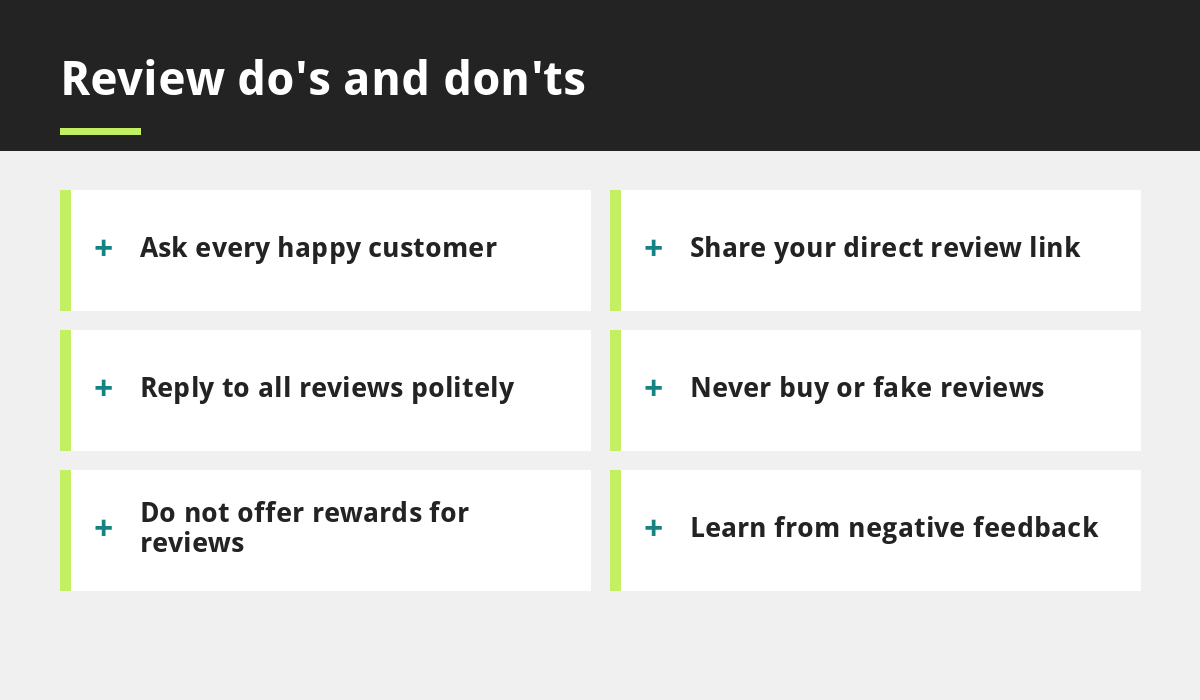
Google’s Maps policies prohibit fake reviews, reviews paid for in cash or kind, and offering discounts, gifts or other incentives in exchange for reviews. They also rule out selectively soliciting positive reviews or discouraging negative ones. When you ask, do not require or pressure customers to leave a review while they are on your premises, do not set review quotas for staff and do not request specific wording or reviews that name a staff member. UK law is strict too: the Digital Markets, Competition and Consumers Act 2024, in force since April 2025, bans fake reviews, undisclosed incentivised reviews, suppressing negative reviews and presenting reviews in a misleading way, and the Competition and Markets Authority enforces it. Always check the latest guidance for your situation.
The safe rule is simple: ask everyone, accept whatever they honestly say and never pay for praise.
Step 1: Get your direct review link
The easier the process, the more reviews you will get. From your Google Business Profile, you can find a link that opens the review box directly. Save it, shorten it if you like and keep it handy. You can add it to emails, text messages and a QR code.
Step 2: Ask at the right moment
The best time to ask is straight after a good experience: when a customer says thank you, after a meal, after a successful treatment or when a job is finished and the customer is pleased. Do not wait weeks, because the details fade. For appointment-based businesses, a short follow-up message later the same day often works well.
Step 3: Ask in a simple, friendly way
Keep requests short and personal. Here are ideas you can adapt:
- In person: If you were happy with your visit today, would you mind leaving us a quick Google review? It really helps a small business like ours.
- By text or email: Thank you for visiting us today. If you have a minute, we would really value your honest feedback. Here is the link: [your link].
- On a card or counter sign: a QR code with a short thank-you message.
Make it clear that you welcome honest feedback, whatever it is.
Step 4: Reply to every review
Thank people for positive reviews and mention something specific if you can. Replies show that you care and encourage others to leave feedback. Keep each reply short and natural rather than copy-and-paste.
How to handle negative reviews
- Pause. Do not reply in anger.
- Check the facts. Find out what actually happened.
- Respond politely and briefly. Thank them, apologise where appropriate and offer to resolve it offline.
- Do not share private details. This is especially important for clinics and other sensitive services.
- Learn from it. Repeated complaints show where to improve.
If a review is fake, abusive or clearly breaks Google’s policies, you can report it for review. Clinics should also read the advice in our clinic website guide on testimonials and advertising rules.
Use your reviews to win more customers
Show genuine reviews on your website fairly: do not cherry-pick only the best or hide the critical ones, and link to your full Google reviews so visitors can see the whole picture. Share positive feedback on social media with permission and give credit. Restaurants, salons and trades can all benefit, and our guides for restaurants, salons and tradespeople show where reviews fit on the page. For wider visibility, see how local SEO helps UK businesses.
Build a simple weekly routine
- Ask every customer who seems happy.
- Check for new reviews at least once a week.
- Reply to each within a few days.
- Share your best review once a month.
- Review feedback themes each quarter.
Mistakes to avoid
- Offering discounts or gifts for reviews.
- Asking friends or family who did not use your business.
- Ignoring negative reviews.
- Arguing publicly with customers.
- Asking only happy customers.
- Making the process complicated.
Frequently asked questions
How many Google reviews does a small business need?
There is no magic number. A steady stream of recent, honest reviews matters more than a one-off burst, and a healthy count helps new customers trust you.
Can I offer a discount for a Google review?
No. Google prohibits offering incentives in exchange for reviews, and it can put your listing at risk.
How do I ask customers for reviews without being pushy?
Ask politely right after a good experience, give them a direct link and make it clear that honest feedback is welcome.
Should I reply to every review?
Yes. Replying shows you care and encourages others to leave feedback. Keep replies short, polite and professional.
Can I remove a bad review?
You can only request removal if it breaks Google’s policies, for example if it is fake or abusive. Otherwise, respond professionally and show how you resolve problems.
Final thoughts
If you want to get more Google reviews, make asking part of your routine: give every happy customer an easy link, reply to all feedback and never cross the line into buying or rewarding reviews. Over time, honest reviews become one of the most valuable marketing assets your small business has.
Need help building a strong online presence? Contact our team.
Sources and further reading
- Google: Prohibited and restricted content (Maps)
- Business Companion: Reviews and endorsements (DMCC Act)
- Google: Guidelines for representing your business on Google
Related reading
- Google Business Profile Optimisation Guide
- How Local SEO Helps UK Businesses
- Restaurant Website Design UK
- Clinic Website Design UK
Launch offer for UK small businesses. Get a professional website for just £299 a year. Only the first 20 customers, for restaurants, small clinics and small businesses.